
Overview
The November 2022 release of ChatGPT sparked a global re-examination of how we learn, teach, create, work, and connect. The Stanford Accelerator for Learning was ready for that reckoning. Long before GenAI captured public attention, Stanford faculty and students—spanning education, computer science, neuroscience, psychology, business, economics, and design—had been exploring the intersection of big data, artificial intelligence, learning sciences, and human-centered design.
The Accelerator’s program in AI + Education supports educators and education leaders as they navigate a rapidly evolving landscape in a few ways:
- Activating new research and design. The program has funded and supported over 30 interdisciplinary research projects on AI and education, leading to key insights in AI tutoring, teacher feedback and instructional coaching, AI literacy, medical education, and personalized learning for neurodiverse learners, to name a few.
- Engaging classroom educators. The Accelerator works with educators and education leaders on AI literacy and professional learning experiences through programs including the AI Tinkery, CRAFT, CSET, and the GenAI Hub for Education.
- Convening teachers, students, researchers, and tech developers. The annual AI + Education Summit, co-hosted with the Stanford Institute for Human-Centered Artificial Intelligence (HAI), brings together researchers, educators, and technologists to learn from each other and chart the future of learning.
- Shaping the field’s most pressing questions. The program works across all seven Stanford schools to ask the big questions and influence the discourse on key questions like AI and cheating and learning through creation with AI.
Faculty Lead

Victor Lee
Associate Professor
Research team
Catherine Chase
Research Director
Featured
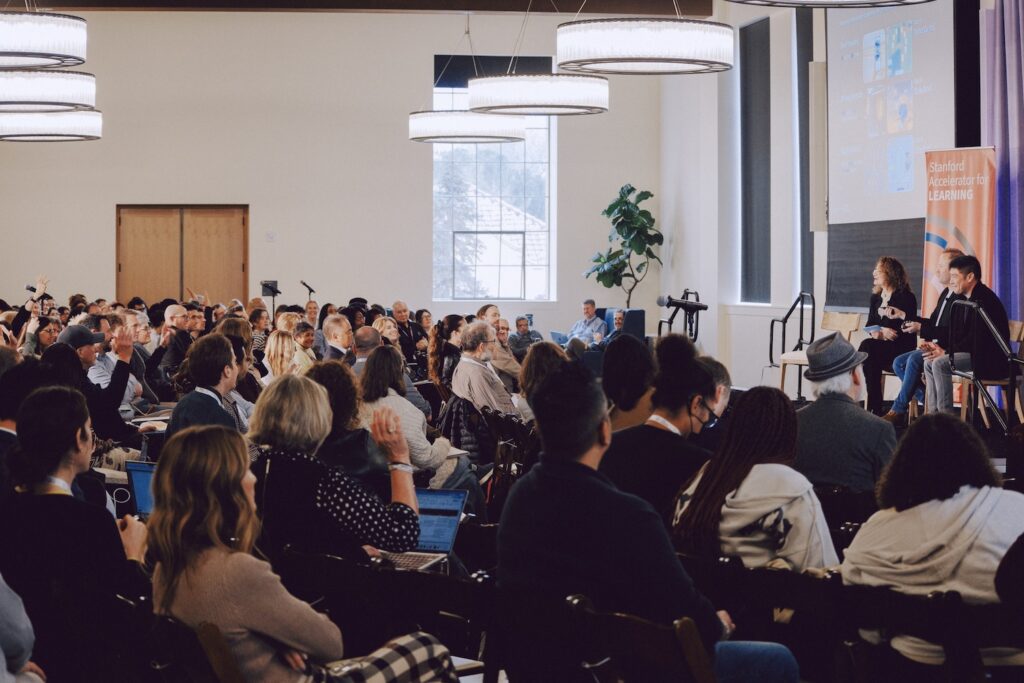
AI challenges core assumptions in education
Seed grants
Generative AI is artificial intelligence that can generate novel content by using existing text, audio files, or images. Generative AI has now reached a tipping point where it can produce high quality output that can support many different kinds of tasks. For example, ChatGPT can write essays and code, DALL-E can create images and art, while other forms of generative AI can produce recipes, music, and videos. These new forms of generative AI have the capacity to change how we think, create, teach, and also learn.
The AI+Education program has collaborated with the Stanford Institute for Human-Centered Artificial Intelligence (HAI), to fund two rounds of early and exploratory stages of research on AI and education, including designs, prototypes, and pilot studies that may have the potential to scale or have broad impact in the future.

Learning through Creation with Generative AI
Generative AI for the Future of Learning
Resources for educators and education leaders
The Stanford Accelerator for Learning works with educators and education decision makers to facilitate the exchange of information and bridge the gap between research and practice. Educators help inform AI researchers and developers about PK-12’s challenges. They also suggest new areas of research and development to help address critical needs within the education system.
Curricular resources
The Curricular Resources about AI for Teaching (CRAFT) project brings together researchers and teachers to co-create resources to teach AI literacies in high school.
AI Tinkery
Housed in the Center for Education Research at Stanford (CERAS), the AI Tinkery is a collaborative space to play and tinker with the possibilities of generative AI in the classroom. It hosts regular events, open hours, and thematic working groups to envision how AI can support teaching and learning.
Professional learning video series
In this series, Stanford faculty share their experiences and perspectives on AI and learning as they respond to questions from educators. Each video comes with a set of discussion questions that teachers can use to self-reflect or engage in conversation with colleagues.