Research and innovation grants

AI in Teaching and Learning at Stanford: Thought Leadership

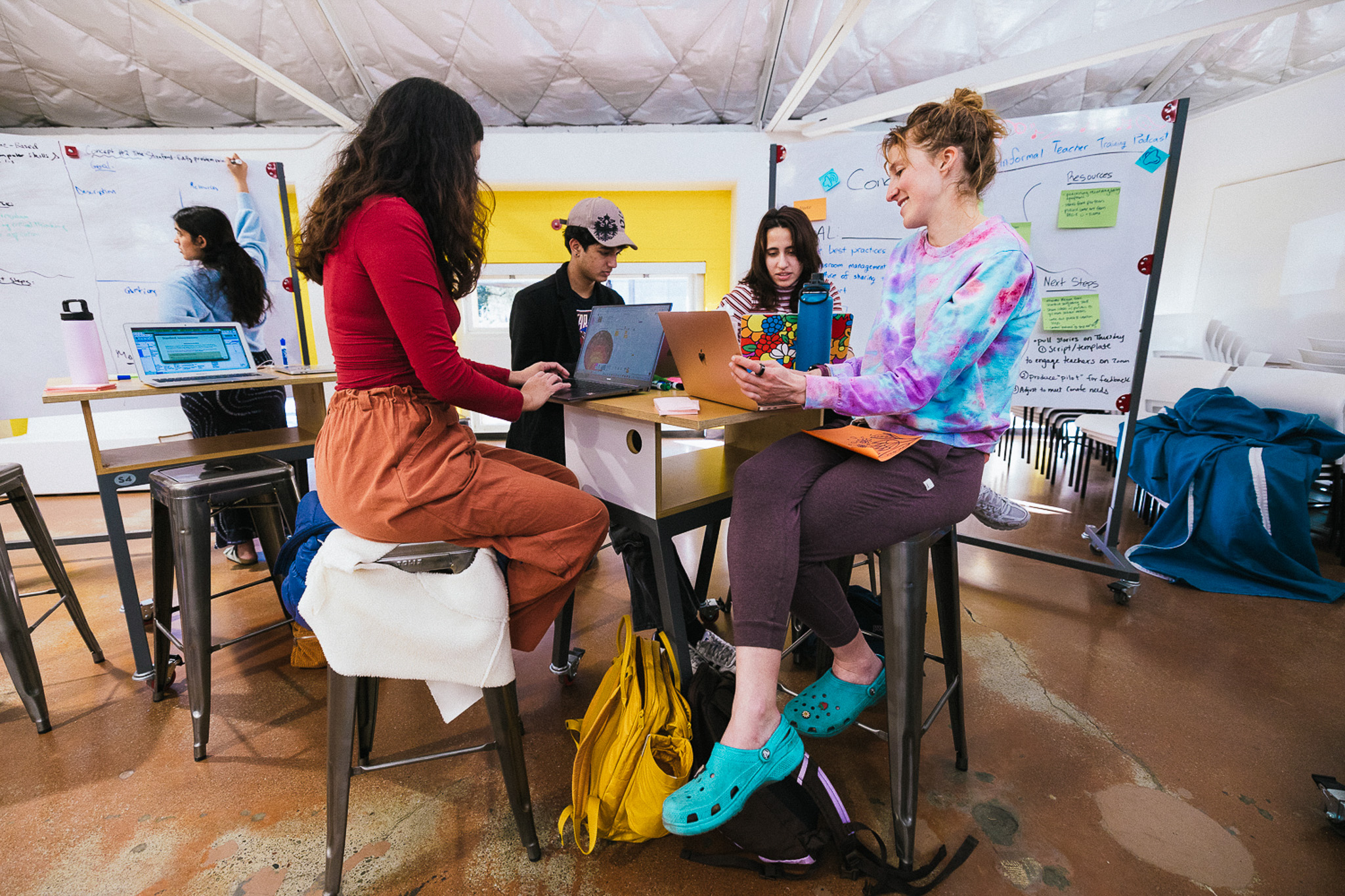
Advancing Stanford’s thought leadership in AI and learning, thi award program funded scholarly work in two sub-tracks: AI and critical thinking, and AI and creativity. Projects involve intellectual products of any form ranging from writing to art to software.

Photo: Andrew Brodhead

Overview

The Thought Leadership program, part of the AI in Teaching and Learning at Stanford seed grant program, solicited proposals for the creation of intellectual works that consider the relation between generative AI and highly regarded human capacities — critical thinking and creativity. There are strong and diverse opinions on the impact of AI on the learning and use of critical thinking and creativity. It is valuable to bring different ideas and formats into productive dialog.

The Thought Leadership competition welcomed proposals for a broad range of intellectual works including thought pieces, policy briefs, art, demonstrations, videos, software, empirical data, and more.

Application

Applications are currently closed

2026 Awardees (Creativity)

Exploring the AI Gaze Through Interactive Portraiture

How might we define the “AI gaze” in AI generated imagery? This experiential project explores AI’s interpretation of seeing humans as patterns and provides visitors an opportunity to shape algorithmic seeing—exploring authorship and the tensions around machine-mediated human depictions.

Project team: Andrea Taylor, Justin Willow

Think More, Not Less: Design for Human Creativity with AI

Many people treat AI as an easy button. This project flips that. Drawing on design education’s principles and conversations with creative practitioners and academics, it offers practical ways to work with AI that strengthen human creativity rather than weaken it.

Project team: Glenn Fajardo

Draw Your Monsters

This project uses the monster as a form factor to capture a complex bouquet of feelings about AI. One hundred participants will draw and annotate creatures representing their relationship to AI, contributing to a collective mural of this moment.

Project team: Carissa Carter

Algorithmic Embodiment and the Reconfiguration of Creativity

Machine learning treats movement as data to be trained. But so do museums, and so does culture. This project pairs a critical essay with a student performance-video that makes visible how bodies, human and machine alike, are trained to perform.

Project team: Gayoung Lee

Field Lessons: Learning Observation with AI-Powered Audio

Students learn to observe by observing. This prototype uses AI-driven audio to guide attention in real places, moving learners to experience how careful noticing surfaces tensions, gaps, and insights they might otherwise walk right past.

Project team: Scott Doorley

(Fan)Art for Art’s Sake: Fandom Communities’ Views of AI’s Impact on Creativity

This project will explore the impact of AI on creativity through an investigation of the perception and impact of AI on internet-based fandom communities, through their creative output. The intended project outcome is a combination of creative and critical works.

Project team: Grace Yifang Liang

The Rabbit Hole: An AI-Driven Exploratory Software Redefining Learning Evaluation Through Student Inquiry and Creative Thinking

“The Rabbit Hole” is an AI-driven learning platform designed to shift education from memorization to curiosity. Through interactive exploration, it evaluates and rewards students not on standardized answers, but on the creativity and depth of their questions.

Project team: Xi Liu

What Counts as Thinking? Defining Creativity and Critical Thinking in the Age of AI

This project develops property-based definitions of creativity and critical thinking, then maps human-AI complementarity across those dimensions — helping educators design AI-aware learning environments.

Project team: Basel AlKanjo, Kenan AlKanjo

2026 Awardees (Critical Thinking)

AI in the Wild: Question Vending Machine

A public installation that repositions AI as an inquiry-generator, not an answer-engine. Visitors drop in a problem and receive a receipt of ten questions across critical thinking categories. An experiment in AI away from personal devices.

Project team: Leticia Britos Cavagnaro

Decoding Digital Blackface in the Age of Generative AI

This project studies the use of AI-generated Black women on social media for political and commercial gain. Incorporating historical research, media analysis, and Black feminist theory, the project’s deliverables include an academic article and teaching curriculum on digital blackface.

Project team: Kristen 'Kay' Barrett

VirtualSP: Using AI Patient Simulation to Study Whether AI Helps or Hurts Clinical Critical Thinking

VirtualSP is an open-source, AI patient simulation whose virtual patient discloses information only when trust is earned through skilled communication. The project studies whether such creative friction strengthens clinical critical thinking and communication skills, pairing the platform with a scholarly essay.

Project team: Alaa Taha, Krish Shah, Helen Xu, Eden Deng, Christine Lee, Amy Tao

Teaching Through the Interface: Conversation Starters as Pedagogical Scaffolds in AI-Mediated Learning

This project examines how instructor-authored prompts embedded in AI learning tools can scaffold critical thinking, self-study, and deeper engagement. Using data from more than 100 California community colleges, it explores how small interface-design choices can shape student learning behaviors at scale.

Project team: Jonathan Trinh, Thomas Dee

Perishable Knowledge: Critical Thinking in the AI Era

Becoming irreplaceable means mastering what machines can’t: perishable knowledge — time-sensitive insights that decay into consensus. Stanford lecturer Collin D. Wallace, offers a framework for teaching the critical thinking that still matters, now that AI has absorbed everything static.

Project team: Collin Wallace

Slower Thoughts

Technological progress accelerates every aspect of our lives. Through the unhurried art of printmaking, Slower Thought sparks a moment of pause as we collectively evaluate the relationship between generative AI and critical thought.

Project team: Romain Speciel

The 3Rs for Learning in an AI-Rich World

As AI transforms higher education, it’s easy to feel lost. This project introduces the 3Rs framework — Relevance, Representation, and Rigor — a practical lens for navigating AI’s impact on teaching and learning.

Project team: Micky U. Sharif

The Trifocal Lens: Critical Thinking About AI in Biomedicine and Longevity

In this three-part Stanford lecture series, Professor Michael Snyder, Professor Ronjon Nag, and Dr. Artem Trotsyuk explore how AI is reshaping biomedicine and longevity through scientific, investment, and ethical lenses. Using real-world case studies, they examine how AI can become a creative partner in discovery while teaching practical frameworks for questioning AI-generated conclusions, avoiding over-reliance on automation, and strengthening human judgment in research, medicine, and innovation.

Project team: Ronjon Nag, Michael P. Snyder, Artem A. Trotsyuk