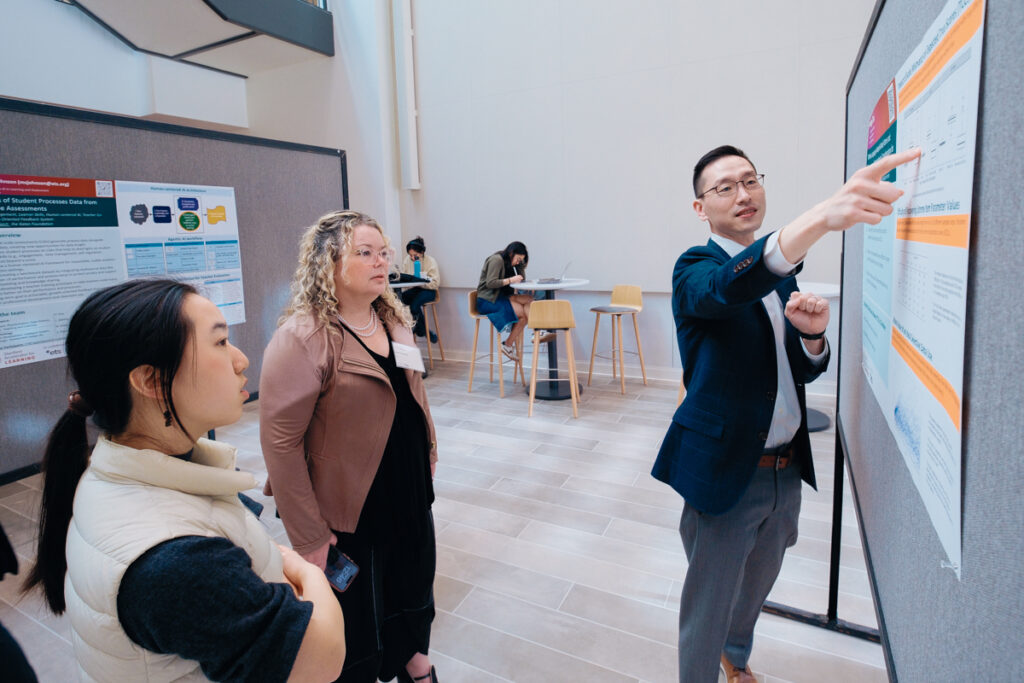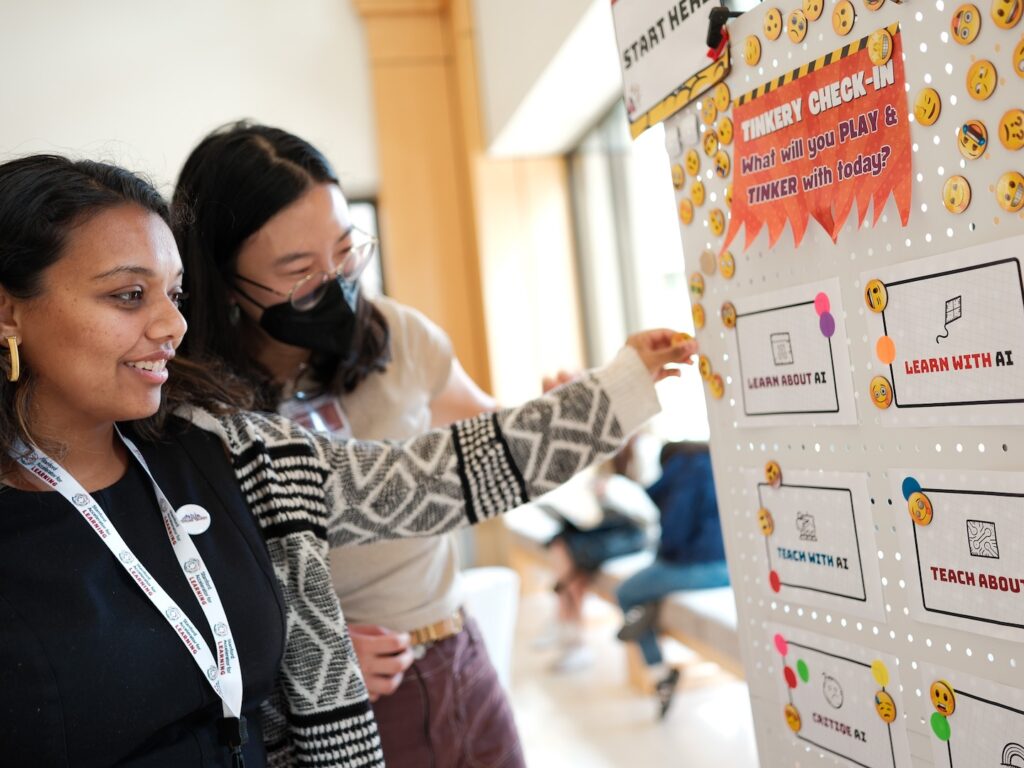
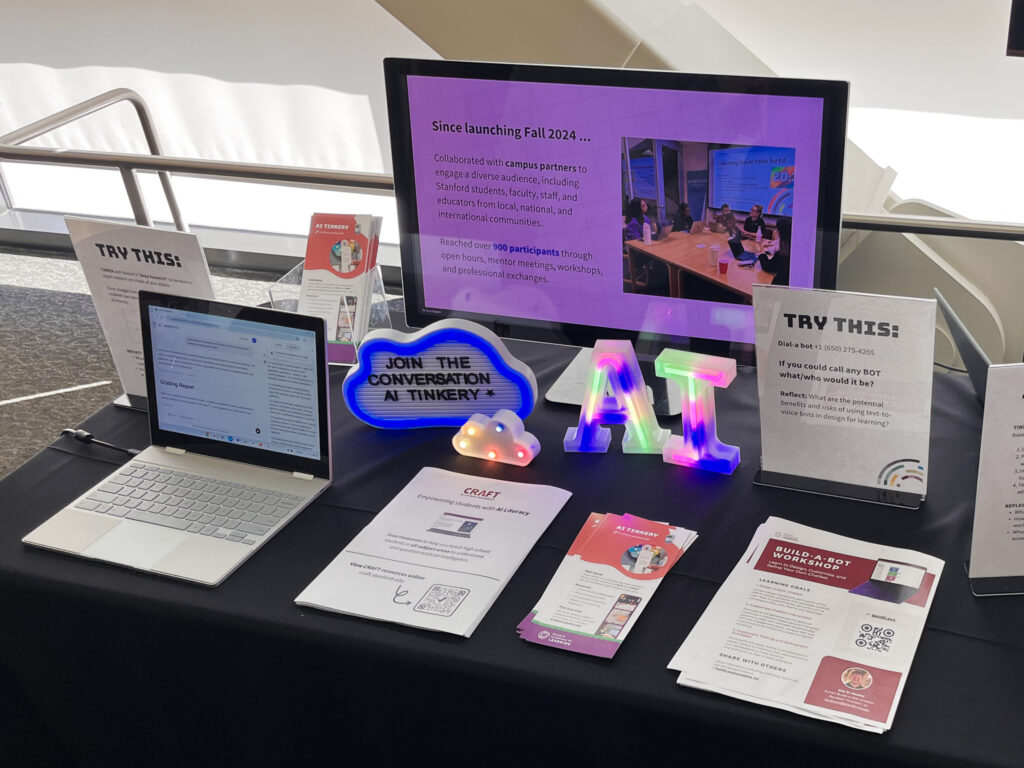
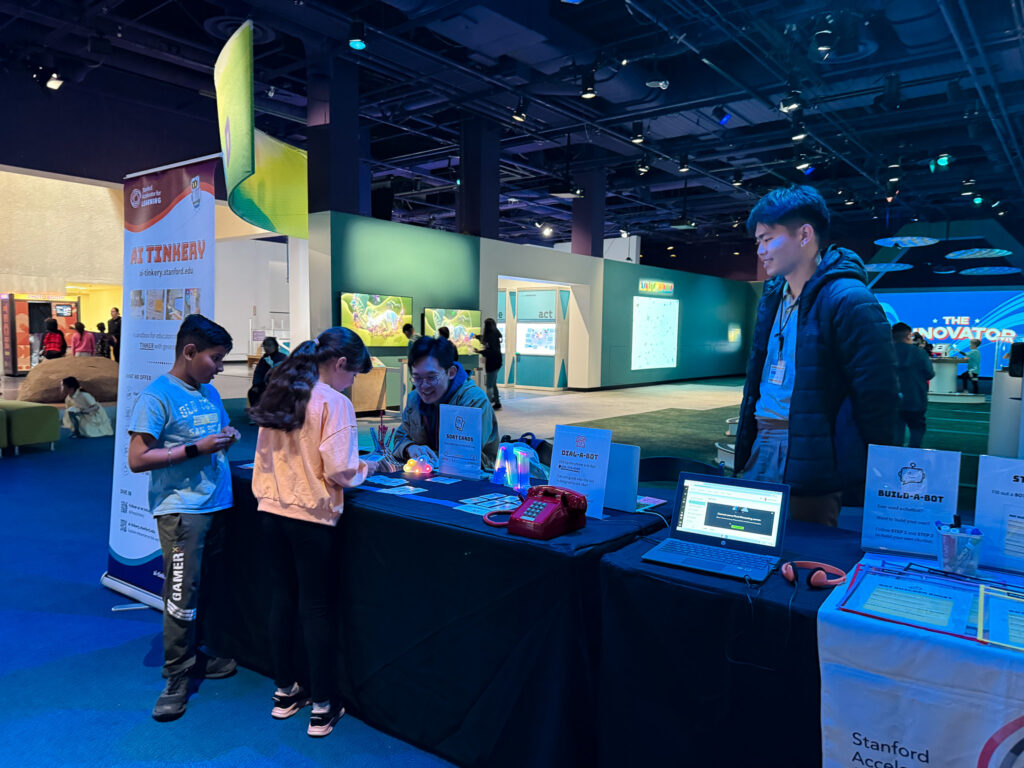
Since 2024, Stanford’s AI Tinkery has been helping students, staff, and faculty across the university explore how AI can support their teaching and learning. With a physical space located in the Stanford Graduate School of Education (GSE) new campus, plus online resources and workshops, the AI Tinkery has created a hybrid place for the Stanford community to play and tinker with generative AI to better understand, use, and shape its role in education.
Now, the AI Tinkery is expanding beyond Stanford, launching a new network and playbook to empower schools across the U.S. and the world to start their own AI sandboxes for educators.
Karin Forssell, founder and director of the AI Tinkery, said that the idea of the network emerged organically. “People just kept asking. People would reach out and say, ‘Hey, can we see what you're doing, and can we do it where we are?’ The answer was simply, yes!”
How does an AI Tinkery work? The origins of the “phygital” makerspace
The AI Tinkery is part of the Stanford Accelerator for Learning, a university-wide initiative that works to connect research to impact, with a focus on the role of AI in education. Dan Schwartz, faculty director of the Accelerator and dean of the GSE, set Forssell a challenge in early 2024: “What would it look like to have a makerspace to learn about and with AI?"
In response, Forssell, who had previously founded the GSE Makery, a hands-on makerspace for education, developed a framework for a “phygital” (physical and digital) learning space to explore generative AI. The AI Tinkery was born.
Physical makerspaces have proliferated in the past decade, and a growing body of research on their benefits for teaching and learning suggests that they can enhance creativity, develop critical thinking skills, support digital literacy, and increase motivation.
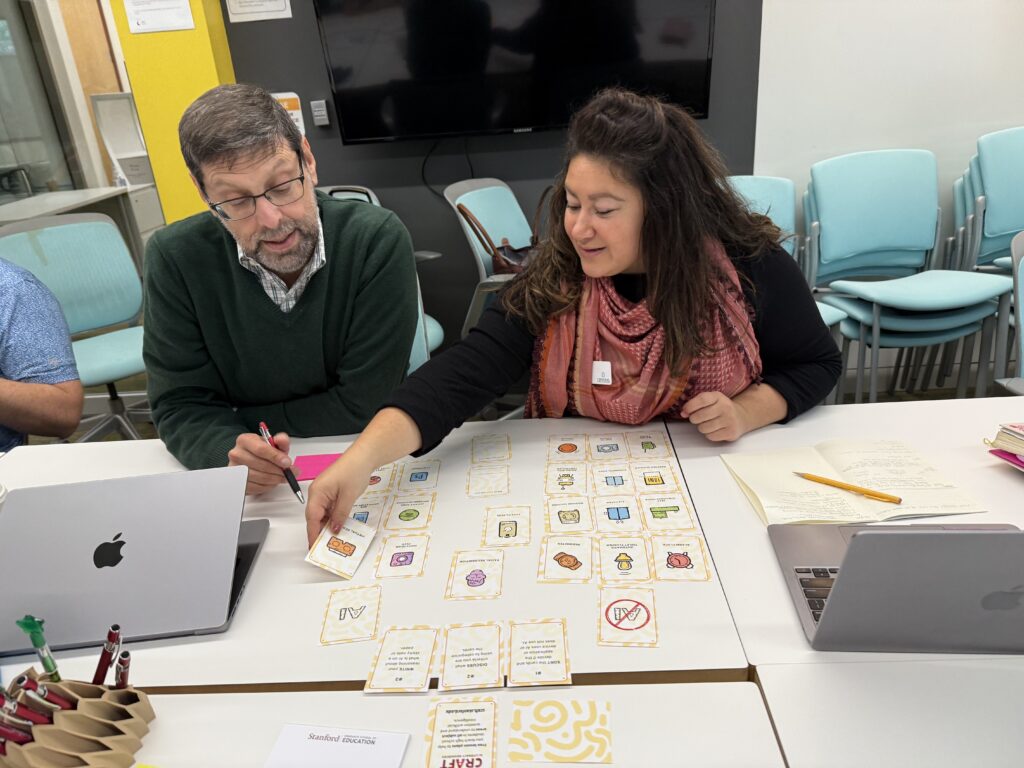
The AI Tinkery experience is designed around the acronym “USE CHAT,” in which participants work to understand, shape, and evaluate AI through activities that are collaborative, human-centered, applied, and thoughtful. For instance, they might play a card game helping them identify what technology is AI-powered or not, or build their own chatbot for a specific educational purpose.
“It's not that we're saying everybody should use AI,” said Forssell. “There are legitimate reasons not to, and times when it's not appropriate. But when it comes to learning about how it works, what it's good for, evaluating the output, shaping its future, then you really have to get your hands dirty by using the chat.”
What does it take to make your own AI Tinkery? A new network and playbook
The new AI Tinkery Network, which is currently free to join and accepting new members, will connect educators and schools building their own tinkeries, facilitate the sharing of best practices and resources, and circulate new ideas and innovations. Forssell also hopes it will become a platform for research into what makes tinkeries effective.
An AI Tinkery can take many forms: it can be hosted on a bulletin board in a hallway, a whiteboard on wheels, or in a dedicated classroom. It can be set up in elementary, middle, or high schools, as well as universities and adult education programs. Most important, says Forssell, is a shared vision of AI exploration and a teacher or school staff member who takes on a leadership role.
Already, the AI Tinkery has expanded its footprint, working with Gideon Hausner Day School in California, the Agnes Irwin School in Pennsylvania, Lakeside Elementary in Florida, the Peninsula School District in Washington, and Kanazawa Institute of Technology in Japan, among others. The new network and playbook will help accelerate similar adoptions across the country and the world, with tinkeries emerging in Europe and Latin America.
The AI Tinkery Playbook is a set of tools that will be provided to all network members to make it easier for schools and teachers to emulate the model. The playbook includes background on the philosophy and learning goals of an AI Tinkery, guidance on the resources needed to launch one, and examples from established tinkeries to spark ideas. It also includes a toolkit of educational activities to play with AI.
“Where playfulness and community meet”
Spaces like the AI Tinkery are crucial as AI tools rapidly evolve and are increasingly embedded in everyday life.
“What I'm hoping that these spaces do is foster the kinds of conversations that will lead to more thoughtful and meaningful implementation of these tools, which, let's face it – they exist. They're not going away,” said Forssell. “This is a way to help people to answer their questions for themselves. It's a relatively approachable model for AI education.”
Jake Stein Greenberg, a teaching, learning, and innovation specialist, described his experience creating an AI Tinkery at the Agnes Irwin School.
"Navigating the constant shifts in education can be challenging, especially when it comes to emerging technology,” he said. “Inspired by Stanford’s AI Tinkery, I launched a similar initiative to help my colleagues explore AI. By fostering a playful, low-stakes environment, we were able to adopt a learner’s mindset and collaboratively and thoughtfully integrate AI into our work and for our students."
“As we move toward closer collaboration with AI, we have to build a sharp sense through hands-on practice, ensuring we remain 'proactive architects of society' instead of letting AI take the lead,“ said professors Tokutaro Hiramoto and Rika Ikeda, who launched the AI Tinkery at the Kanazawa Institute of Technology, in an email to Forssell. “This is why the AI Tinkery is so essential. It offers a space where playfulness and community meet.”