As we live longer lives and technologies like AI transform nearly every industry, the familiar presumption of a life course — go to school, work for several decades, then retire — is getting harder to sustain.
“Human lives essentially doubled in length during the 20th century, and workplaces today are changing at a staggering pace,” says Mitchell Stevens, a professor at Stanford Graduate School of Education (GSE) and co-director of the Stanford Center on Longevity. “If we want people and the country to prosper, we need to rethink how we invest in human capital, and we need to develop new ways of supporting talent throughout adulthood.”
Stevens has been grappling with these issues for years, directing efforts at Stanford such as the Pathways Network and the Futures Project on Education and Learning for Longer Lives to rethink inherited models of learning and work.
Throughout 2024 and 2025, he brought together thought leaders from academia, private industry, venture capital, philanthropy, government, and other sectors to imagine how schools, workplaces, and communities could better enable people to work and flourish over the next 25 years.
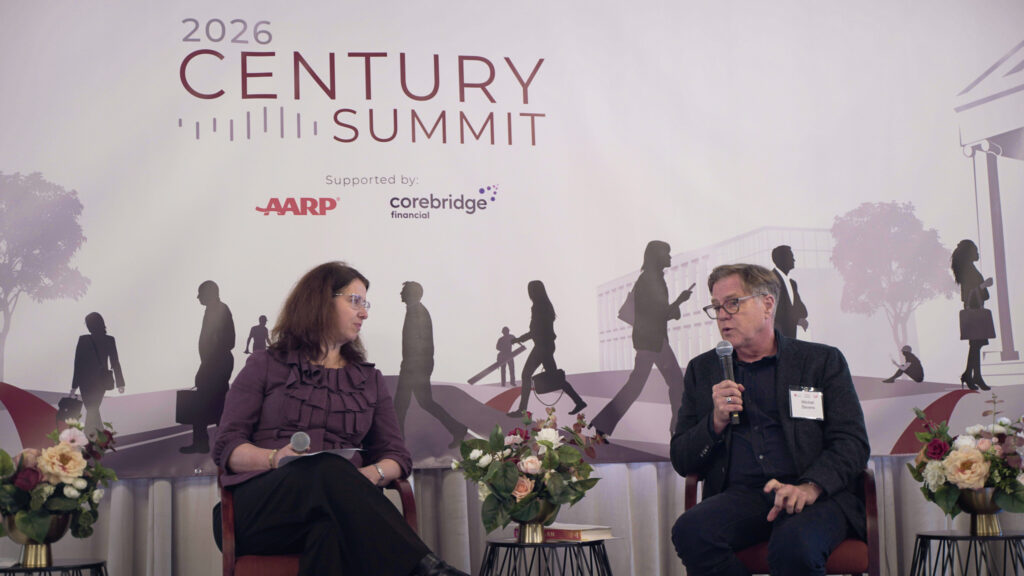
These conversations laid the groundwork for Learning Society, a new initiative exploring policies and practices to encourage innovative approaches to education, employment, and the life course. The initiative launched in February during Century Summit VI, an annual conference co-hosted by the Stanford Center on Longevity and the Longevity Project.
Here, Stevens talks about the difference between learning and schooling, the future of work and learning as technology transforms labor markets, and who bears responsibility for supporting learning across the life course.
You have some critiques of our conventional model of education, where we go to school until maybe our 20s to prepare for a lifelong career. What could we be doing differently?
The vast majority of public investment in education in this country is concentrated in the first two decades of life, with much less attention to sustaining learning for adults. We’re front-loading our investments, presuming that people will devote young adulthood to accumulating school certifications for stable work they’ll do throughout their adult lives.
This made sense when we first accomplished universal mass schooling for children at the beginning of the 20th century, and even when we dramatically expanded college access after World War II. But in 2026 it’s a very short-sighted way of thinking about human capital – especially when a lifetime could last the better part of a century and workplaces are changing, it seems, almost by the hour. There’s a lot of uncertainty about what demand for distinctively human talent will look like even in the near future. And, frankly, a lot of fear.
And of course Americans never figured out how to make educational opportunities equitably available for everyone. In higher education we built a clearly unsustainable model that systematically indebts millions of people, rather than making them wealthier.
Perhaps most tragically, we’ve tied so many social values – not just careers and earnings, but also basic human worth and dignity – to the amount and kind of school credentials people manage to attain.
That model is so deeply ingrained in our society. How do we make other paths more viable?
A powerful first move is to distinguish schooling from learning. Schooling is a largely bureaucratic process. It happens in designated formats and places, it’s organized around credentials and certifications, and it’s associated with organizational arrangements designed for the first two decades of life.
Universal schooling was a huge civic accomplishment, and the nation was positively transformed by it. The world is different now, but the basic logic and rhythms of schooling have barely changed. Stanford historians David Tyack and Larry Cuban famously named this problem in the 1990s. They called it “the grammar of schooling,” and it profoundly limits our imaginations about how, when, and where we support human development.
Learning does not have those constraints. It happens everywhere. It’s agnostic about credentials. It unfolds very differently in workplaces than it does in schools. We know that the best learning happens by doing, typically on teams and alongside other people who are more experienced in what is being learned. And it appropriately spans the entire life course. Schooling and learning imply very different ways of investing in talent.
We can honor the pivotal importance of schooling in the first two decades of life, but also recognize that we’re well served when people have the flexibility to learn continually and adapt their skills for different kinds of work over time.
What would that reorientation look like, in practical terms?
Right now we have a civic architecture that funds, governs, and organizes schools. But we need one that funds, governs, and organizes learning, wherever it occurs: at school, at play, at worship, at leisure, and perhaps especially at work.
Think about a more episodic life course in which people move in and out of and across jobs, between jobs and full-time learning, between paid employment and caring for others or themselves. Are there pieces of the human capital system that we could tune in this direction?
What might high school look like if going to college immediately after senior year were only one of several, equally honorable next steps? What if we blurred the boundaries between school and work for young people so that they moved back and forth between classrooms and paid employment on a monthly, weekly, or even daily basis? What if high school and college classes took place in office towers and on shop floors?
Many companies and entrepreneurs are developing business models that commingle work and learning. But of course learning is not only a business venture. It’s also a civic necessity. A functioning economy and civil society arguably require continuous human learning.
What would it take to make that happen?
Historically, throughout every period of major technological change, America has responded with fresh investment in human talent. When the Soviet Union launched the Sputnik 1 satellite into Earth’s orbit in 1957, it created a wave of anxiety in the United States and ushered in a whole new era of investment. Miraculously – at least by today’s standard – in the space of 11 months Congress passed the National Defense Education Act (1958), omnibus legislation that provided funding at all levels and a huge influx of money for higher education.
I’ve taught the 20th century Cold War to students for years, and for a long time it was hard to convey how much fear and public action Sputnik 1 initiated. I don’t have a hard time explaining that kind of anxiety anymore, because my students and their families are now feeling it under the spectre of AI.
But so far, we have failed to do what our grandparents achieved with NDEA. Where’s the massive new commitment to growing human talent? We need to change that.
Who pays for this kind of long-term investment in adult learning? And how?
Your question names the central question we’re surfacing with Learning Society. Who is responsible for the lifelong employability of the American people? For our economic and civic vitality?
We believe the task of growing human talent should be shared by everyone who benefits. That means business at least as much as government, alongside families, philanthropies, and individuals themselves.
Right now, in terms of human-capital investment, the only thing we’re owed in this country is a high school diploma. Is that good enough for a functional society in 2026? If the answer is no, then what else are we owed, and who will pay for providing it? These ultimately are political and normative questions, not technical ones. Nailing the answers may be the most urgent civic challenge of our time.
This story was originally posted by the Stanford Graduate School of Education.