Research and innovation grants

Create+AI Challenge

The Create+AI Challenge invited educators, researchers, technologists, and students to imagine how artificial intelligence can advance learning, augment teaching, and expand opportunity, always with humans at the center.

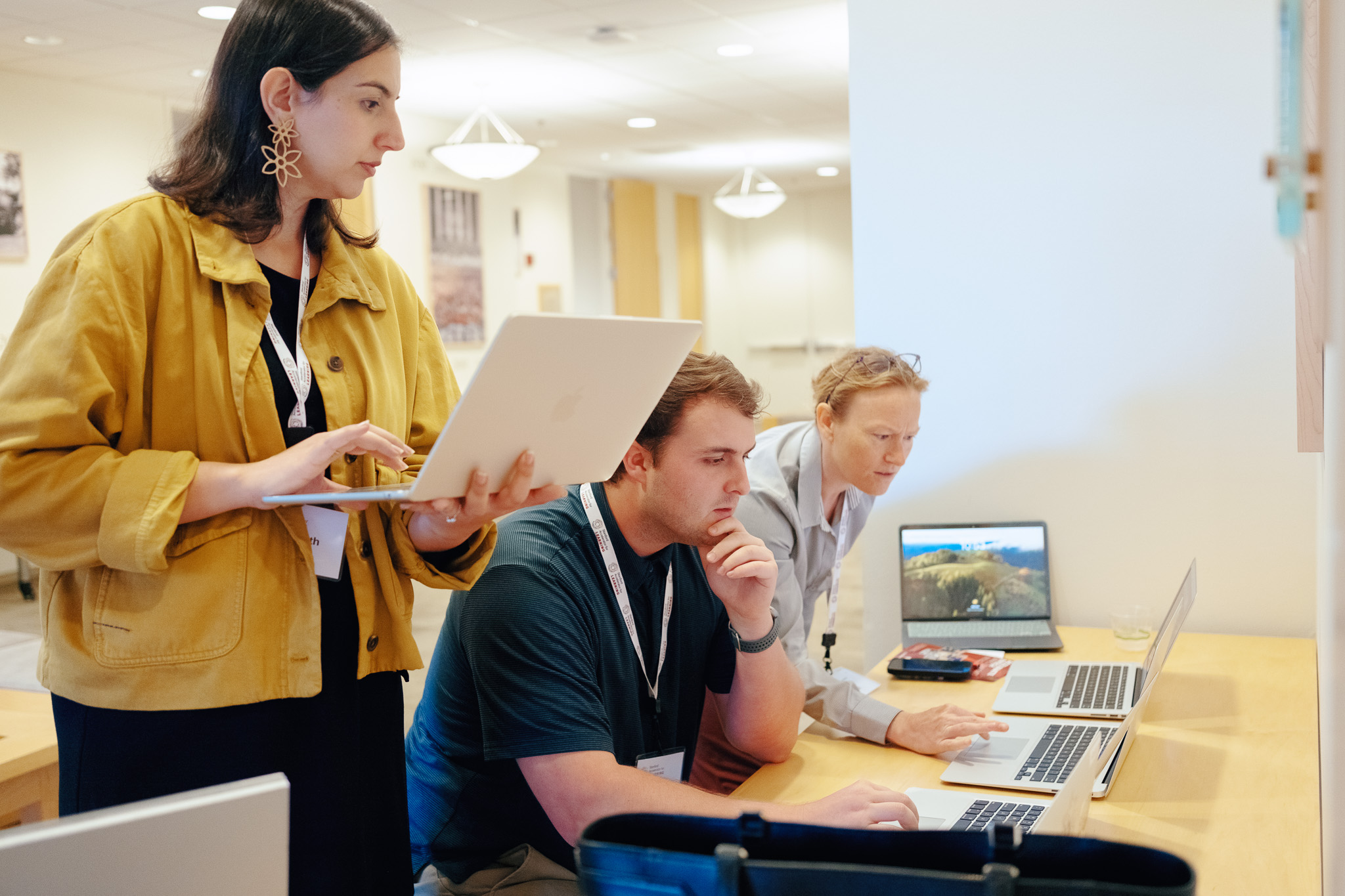
Three adults in business casual wear look at laptops, co-working in a Stanford space.
Photo: Ryan Zhang

Overview

Too often, AI in education is used for automation. The Create+AI Challenge—hosted by the Stanford Accelerator for Learning with support from Google.org—asked a different question: How can AI augment human potential?

We wanted to surface projects that put educators and learners at the heart of AI design—ensuring these tools expand access, agency, and connection, and in turn advance learning, well-being, and opportunity.

View awardee pitches on YouTube

Tracks

Applicants selected one track. Each centers on how AI augments human talent and interactions to advance learning and teaching.

  • Augment Teaching: AI solutions that respond to teacher pain points in their work, especially those that enable or enhance the ability to develop the social relationships with students in school.
  • Augment Learning: AI learning tools that foster participation, especially for learners with disabilities or learning differences.
  • Augment Career Opportunities: AI solutions that support skill-building, mentorship, and pathways to meaningful work.

What’s involved

  • $400,000 in total funding across multiple awards, including:
    • Two $50,000 awards in each of the three tracks of “Augment Teaching,” “Augment Learning”, and “Augment Career Opportunities”
    • Multiple other awards ranging from $10,000-$20,000 across all three tracks
  • Mentorship and connections with Stanford faculty, researchers, technologists, and collaborators, including learning science and teacher co-design workshops
  • Visibility at the AI+Education Summit (February 10 and 11, 2026)
  • Potential invitation to continue project development at Stanford in a summer 2026 cohort

Selection Criteria & Scorecard

Proposals were reviewed by a panel including educators, researchers, technologists, and learners.

Each submission was scored on the following criteria: (i) innovation & creativity; (ii) learning impact; (iii) fairness & inclusion; (iv) use of learning sciences & design; (v) measurement plan; (v) feasibility & sustainability.

Application

Applications are currently closed

Awardees: Augment Teaching

Co-Designing How We Teach Process-Based Student Analytical Writing

The team will create and evaluate a teaching process that uses AI to help students plan their analytical writing. This will involve creating and evaluating an AI-based tool that supports the teacher and student, drawing on the team’s decades of high school English teaching experience. In broad terms, a student carries out an analytical writing assignment in three phases: (i) Understanding the Text & Developing an Idea, (ii) Organizing Ideas & Mapping An Argument Arc, (iii) Drafting & Revising the actual writing to produce a finished essay. Focusing initially on the first phase, the team will build an initial prototype tool that will lead a student through a series of steps, using AI to respond to student input and allowing the student to either iterate or go on to the next step. The team will first test this tool with experienced high school students who have completed relevant writing courses. After refining the tool with these design partners, the team will test the teaching methodology and tool with ninth grade high school students taking analytical writing classes.

Team: John Mitchell, Jake Moffat, Diana Neebe, Ishita Gupta

The Math Adaptation Playbook

This project leverages multimodal LLMs to support teachers in adapting math lessons using structured, research-based prompts grounded in Stanford’s eight Math Language Routines. The approach begins with a needs assessment with LBUSD teachers to understand workflows, pain points, and risk tolerance with AI. The team will then design baseline prompts aligned to MLRs and refine them through teacher co-design and workshop testing. A teacher workshop evaluates usability and effectiveness on authentic materials, generating feedback for iteration. The outcome is a practical Adaptation Playbook (documented prompts, examples, and routines) that enables teachers to quickly produce intentional, differentiated, and personalized materials for EL students.

Team: Aisha Nájera, Akhil Shah, Ami Radunskaya, Tammy Kwan

Small Books, Big Lessons: Building Belonging and Bias Awareness Through Children’s Literature

Children’s books open doors to big conversations around identity and belonging, but these complexities can be daunting for educators. In this approach, AI will act as a reflection and coaching companion for educators. Before instruction, educators engage in guided reflection prompts that invite consideration of their multifaceted identities, lived experiences, assumptions, and the specific students in their classroom. These prompts are designed to slow educators down, surface intentionality, and consider how they’re approaching the lesson. Based on the selected text, the tool will suggest common student questions or comments, including moments of misunderstanding, bias, or curiosity. These are framed as possibilities, not as predictions. Rather than scripts, the tool will offer values-aligned response pathways that might be curiosity-based, restorative, or affirming. Afterwards, educators will engage in a post-lesson reflection to strengthen learning and relational practice over time. The system is designed to encourage educators to pause for reflection, thoughtful decision-making, and human connection.

Team: Marissa McGee

UGood?: An AI-Driven Tier I Attendance Engagement System Supporting Underserved Students

This project uses AI to support — not replace — human relationships at school. First, the system uses existing student data (e.g., student surveys, teacher-inputted data, attendance patterns) to generate brief, student-specific, low-stakes check-in questions. Based on student responses — or non-responses — to these check-ins, the AI drafts concise, empathetic follow-up messages that are supportive and non-punitive. Teachers review, edit if needed, and send messages with a single click, ensuring educators retain voice, judgment, and decision-making authority. The system also aggregates weekly check-in and engagement data into actionable insights for educators (e.g., participation trends, common needs, and students requiring follow-up). The platform can flag language that may indicate concerning distress levels and prompt appropriate next steps through an escalation workflow, while keeping educators firmly in the loop and avoiding fully automated outreach. AI handles pattern recognition and drafting; educators provide the human relationship, context, and care.

Team: Adam J. Siegel, Jonathan L. Montoya, Lindsey Couto

Awardees: Augment Learning

Flourish: Augmenting Learning Capacity in Community Colleges with Human-Centered AI

Flourish uses AI to augment human learning environments through a scientifically validated AI-native app. Within the Flourish app, students interact with Sunnie, a human-centered AI well-being coach that provides emotionally intelligent, science-based guidance through brief daily interactions. Sunnie helps students set goals, practice evidence-based well-being strategies, and build positive learning habits. The AI’s memory system adapts to students in real time, helping create personalized, actionable practices. The Flourish Challenge embeds this AI experience into classrooms through an instructor-ready structure that integrates seamlessly into existing courses without adding instructional burden. During the Challenge, students are asked to use the Flourish app once per day for a short period of time, engaging with the practices in whatever way feels most relevant to them. Flourish provides all core materials, including introductory slides and reflection prompts. The Flourish Challenge has already been implemented in more than 30 learning communities, including community college classrooms. Students consistently report meaningful improvements in reflection, motivation, stress management, and learning engagement, describing the experience as practical, transformative, and supportive of their academic success.

Team: Julie Cachia, Xuan Zhao, Tianyi Xie

Freadom App: Augmenting Foundational Literacy Through AI-Enabled Personalization and  Habit Formation

The Freadom App uses AI to strengthen the weakest points of the early literacy ecosystem — diagnosis, differentiation, sustained practice, and access — while keeping teachers and learners at the center. First, AI-enabled diagnostics track core predictors of reading success. Baseline and endline assessments are translated into clear learning progressions, allowing teachers and program partners to identify gaps, monitor growth, and target support without adding assessment burden. Across recent implementations, learners have shown an average 59% improvement in foundational reading outcomes. Second, Freadom uses empirically validated personalization to match children with level-appropriate, engaging content based on their reading behavior and proficiency. This approach has significantly increased engagement and overall usage, enabling differentiated practice at scale in classrooms where one-to-one instruction is not feasible. Third, AI-informed gamified routines support habit formation. A Stanford-led randomized study showed that structured reading challenges led children to read substantially more, with effects persisting even after incentives ended. Finally, Freadom is developing a pedagogy-aligned generative AI system to responsibly expand access to safe, level-appropriate reading material in low-resource and multilingual contexts, augmenting teacher-led instruction and curated content.

Team: Nikhil Saraf, Susan Athey, Kristine Koutout, Sowmya Balaraman, Mansi Gupta, Nivruti Tagotra

From Play to Insight: Advancing Research on Kids and AI

Scratch 4.0 uses AI to amplify imagination, curiosity, creativity, and connection. Its new AI-powered tools are designed to support young people as learners and creators by helping them get unstuck, explore new ideas, and engage meaningfully with others. The Creative Learning Assistant offers opt-in guidance that encourages creative problem-solving without replacing the learning process. This support extends into the community through AI-powered features that help learners discover projects and peers who broaden their interests and spark unexpected inspiration. For educators and researchers, Scratch’s global scale and engagement data offer unprecedented insights into how young people learn, collaborate, and express themselves in digital spaces. This project ensures that the rich data generated by Scratch’s new AI tools becomes a shared resource: ethically captured, anonymized, and accessible to the global research community. In doing so, it expands the ways tens of millions of young people can be supported in their learning journeys, while informing a more ethical and child-centered vision for AI in education.

Team: Maira Janelli, Bruce McCandliss, Margaret Honey, Nikita Khalid

Generative AI–Enhanced Behavioral Learning Lab for Children with Autism

The team will adapt GuessWhat decks to target social-communication skills. Teachers and parents will incorporate these activities into daily routines. New decks will be co-designed with educators, therapists, and families, ensuring cultural inclusivity and close alignment with each child’s IEP. The videos generated through gameplay will be analyzed with multimodal machine learning models that combine visual, audio, and motion data, tracking behavioral signals such as gaze, gesture, prosody, and facial affect. Transformer-based architectures and time-series modeling will capture developmental change across repeated sessions. This analysis process will generate progress summaries that are shareable with teachers and parents. The team will develop generative AI systems capable of producing novel prompts, stories, and social scripts that adapt to each child. For instance, a child struggling with peer interaction may receive an automatically generated playground scenario with customized characters. By linking classroom measurements and AI-derived measures, this project will create a longitudinal dataset that captures developmental trajectories. This will constitute the basis of a pediatric developmental foundation model, an AI system that can dynamically guide personalized therapy and learning.

Team: Dennis Wall, Aaron Kline, Arman Husic, Mahdi Honarmand, Parnian Azizian, Kaiti Dunlap

Math! Everywhere!

MathTalk is using AI to build student, teacher and parent capacity to notice, explore and share math all around them. For students this means utilizing AI to “see” more math in their environment and to generate visual representations of that math that enable the students to play with once abstract ideas. In addition to connecting learning math in the classroom to the community students live in, M!E! aims to cultivate teacher curiosity in order to foster both a sense of inquiry and an asset frame for making sense of and supporting children’s mathematical thinking (Osuna & Munson, 2023). Curious teachers are more likely to notice assets in children’s thinking. Noticing assets in children’s mathematical thinking is a critical skill, as it enables teachers to recognize and harness diverse mathematical knowledge rooted in students’ cultural backgrounds and everyday life. AI will be used as a resource to not only expand what students and parents “see”, but also as a resource to expand what teachers “see” and the types of questions they may think to ask to strengthen connections between math in the classroom and in the community.

Team: Omo Moses, Savitha Moorthy, Gabe Arniella, Ashley Payton, Tiffany Enciso Williams
Awardees: Augment Career Opportunities

AI Studio Teams

AI Studio Teams creates cross-grade teams of 10-12 high school students who complete real projects for local employers while learning to work responsibly alongside AI. Students build employer-validated portfolios demonstrating actual capability—not just credentials. Near-peer mentorship (12th graders mentor 10th; 11th mentor 9th) recreates developmental relationships disappearing from workplaces. AI tools are embedded throughout with a Responsible AI Framework teaching hallucination detection, appropriate use boundaries, and transparency standards. Local employers provide quarterly project briefs, portfolio reviews, and micro-internship pathways. This puts educators and learners at the heart of AI design, ensuring tools expand access and opportunity.

Team: Keith Coleman, Charles Sims, Mike Belloli

Bella AI

Bella is an Agentic Student Information System designed to automate compliance and drive student success. To support school administrators, Bella AI systems track student accounts for compliance with Title IV regulations, automatically identifying compliance gaps, and generating the documentation schools need to stay compliant — replacing the fragmented spreadsheets and manual tracking schools currently use. The team is building natural language processing capabilities to interpret complex federal regulations and translate them into actionable guidance. For students, Bella AI is developing systems that digitize enrollment workflows and provide real-time progress visibility, so students can gain clarity on their learning journey — transforming historically opaque offline processes into transparent, supportive experiences. For instructors, AI-enabled dashboards surface which students need support before they fall behind, while automating administrative tasks like attendance tracking and progress reporting. This frees instructors to focus on hands-on teaching. By automating administrative complexity, Bella allows trade schools to focus resources on what matters: delivering quality vocational training that prepares their students for prosperous careers in our new AI economy.

Team: Touré Owen, Varum Ram

ReadSideKick

Read SideKick functions as an on-demand reading tutor, meeting adult learners wherever they encounter challenging text. When the founder’s brother wanted to read New York Times articles, the team developed a Chrome extension that uses AI to adapt content to his reading level. The system employs a large language model to parse highlighted text and rewrite it at lower complexity while preserving meaning. A learning mode progresses line-by-line, explaining vocabulary and sentence structure, essentially modernizing the dictionary through AI to help anyone improve their literacy. Over the past year, ReadSideKick’s current version has processed 1.2 million words and has 125 installs with no paid marketing. The team is now developing an English-to-ASL translator using AI-generated animations. This requires creating a “written” ASL language, a significant technical challenge. The team has hired an ASL translator to create a training dataset and purchased motion capture equipment to accurately record ASL signs. This innovation will provide Deaf users direct visual access to content in their native language.

Team: Hiroshi Mendoza, Christine Chelakkatu, Guadalupe Valdes