Overview

The Accelerator and AI

Artificial intelligence (AI) holds great promise to make learning more effective, more engaging, and more equitable—but only if guided by the science of learning.

Across all six initiatives, the Stanford Accelerator for Learning is providing new research, learning, and convening opportunities that bring together leaders from education, science, and technology to chart an ethical, informed, and exciting path for the future.

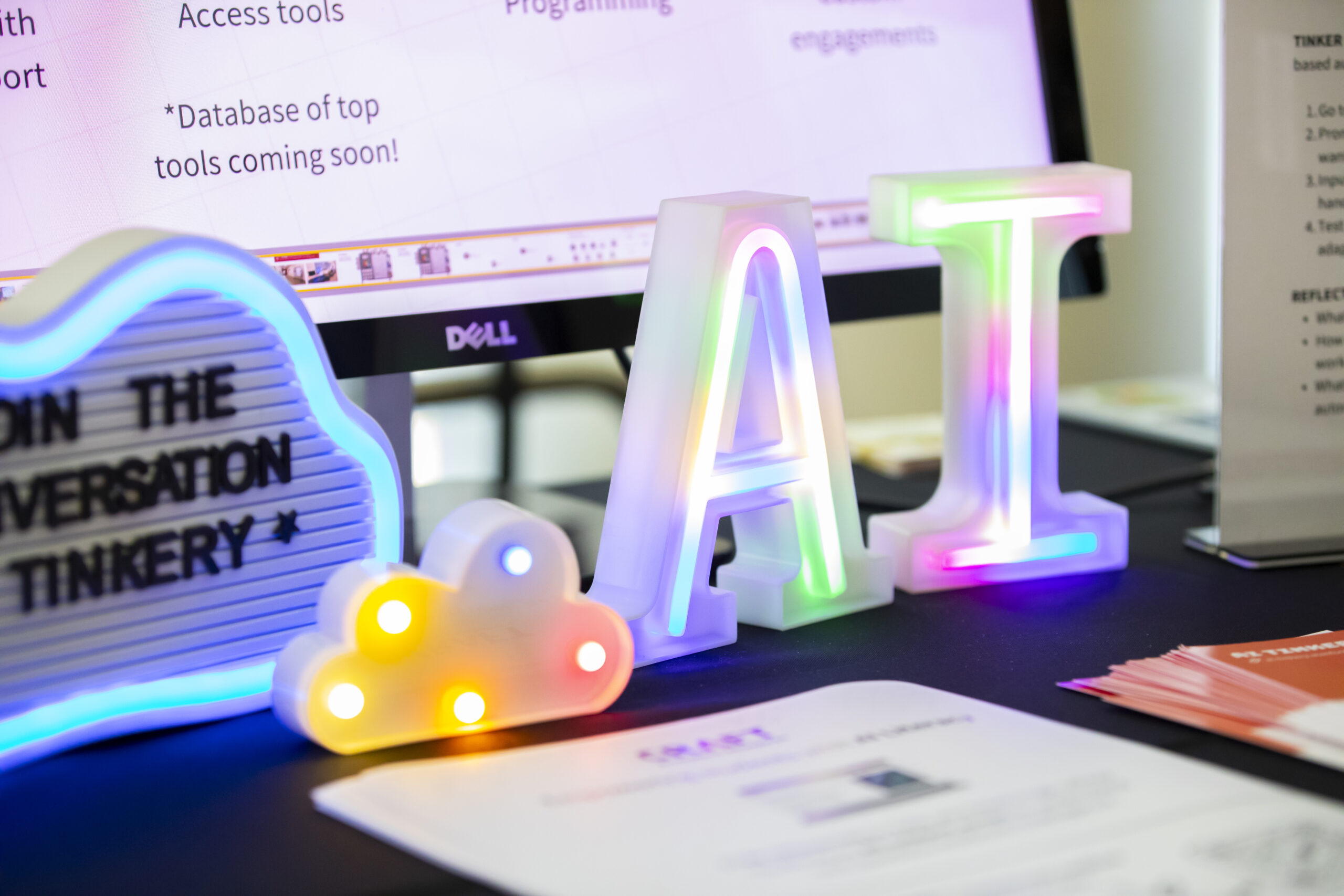
A closeup of a table set up with a desktop computer, glowing plastic decorative letters that say "AI", and a small board with letters that say, "Join the conversation, AI Tinkery."
Credit: Christine Baker

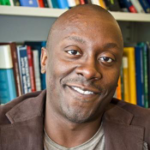
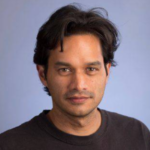
Generative AI for the Future of Learning seed grantee Chris Mah discusses his work with writing teachers and ChatGPT.

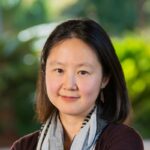
Generative AI for the Future of Learning seed grantee Karen Wang discusses her work on scaffolding learning with AI.

A game of "AI or Not?" from the AI Tinkery to celebrate National AI Literacy Day at San Jose’s Tech Interactive.

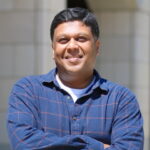
Behind the scenes of the Build-a-Bot Workshop hosted by Josh Weiss and Reuben Thiessen of the Accelerator Studio.

44

faculty working on AI

60+

AI-focused events hosted

32

AI seed grant projects

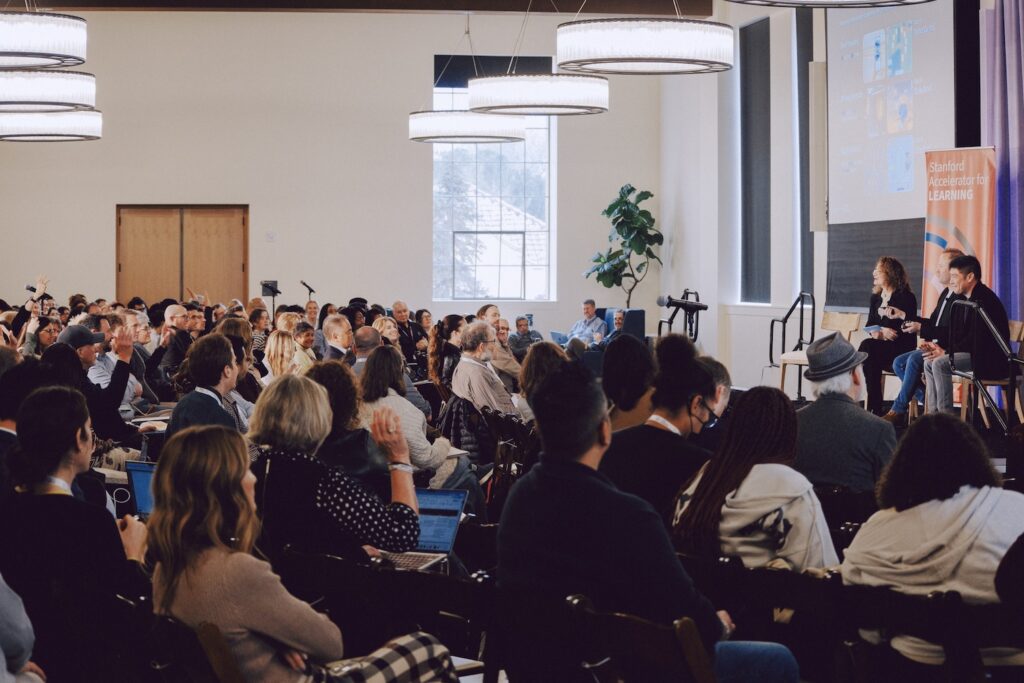
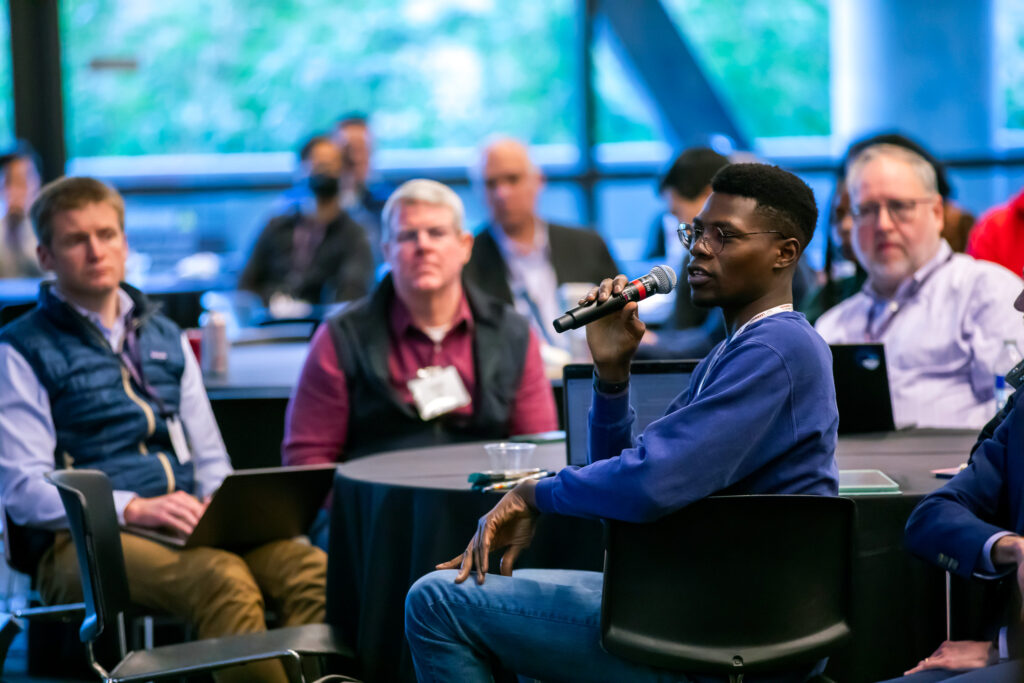
By connecting researchers, policymakers, and educators at events like the annual Accelerate Edtech Impact Summit and the AI + Education Summit, the Stanford Accelerator for Learning aims to build a conscientious, research-informed community to co-create the future of learning.
Link to read

The future is already here: AI and education in 2025

The third Stanford AI+Education Summit brought together researchers, K-12 leaders, educators, and technologists to explore how AI is shaping teaching and learning.
read →
Link to read
Two men sitting on stage together laugh congenially.

Stanford conference explores education technology in the age of AI

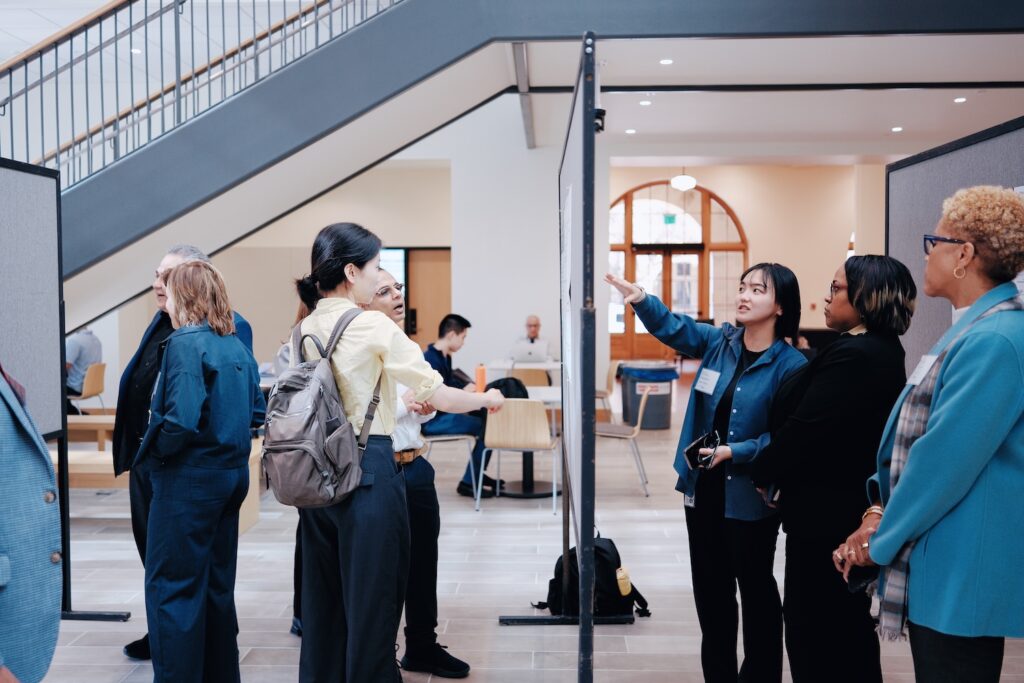
The Stanford Accelerator for Learning convened edtech leaders, researchers, funders, educators, and students to envision effective, research-backed, equitable, and responsive education technology.
read →
Link to read
Dan Schwartz speaks behind a podium with the Tech museum's logo.

Stanford teams up with The Tech Interactive and Bay Area school leaders for inaugural National AI Literacy Day

One of three events held across the country, the first annual day of action promotes AI literacy through education.
read →

Faculty affiliates across disciplines are driving a wide variety of projects that collaborate with educators in AI design and adoption. Learn more about a few of our in-progress projects.

EduNLP Conference 2025
Bringing math teachers to the table
The Stanford EduNLP Lab, led by Accelerator Faculty Affiliate Dora Demszky, hosted a two-day summit bringing together math teachers, leaders, and coaches with diverse perspectives on AI in education — from skeptics to optimists — to reimagine how language technologies like Natural Language Processing can serve mathematics education.
Maximizing Effective Teaching with AI (META)
AI teacher training in Germany
The Stanford Accelerator for Learning, in collaboration with the Robert Bosch Stiftung, launched the program “Maximizing Effective Teaching AI (META): AI Professional Development and Capacity Building for Teacher Trainers” in Germany. The META program equips teacher trainers with the skills to guide educators in integrating AI into their practice.
Curricular Resources about AI for Teaching (CRAFT)
Free AI resources for teachers
Led by AI + Education Faculty Lead Victor Lee, the Curricular Resources about AI for Teaching (CRAFT) project brings together researchers and teachers to co-design resources to teach AI literacies in high school.

Programs across the Accelerator support the exploration of AI and learning in collaboration with educators, students, and the Stanford community.

Link to Learn more

AI + Education

As generative AI technology becomes increasingly widely used and technologically advanced, the Stanford Accelerator for Learning is responding rapidly to guide the use of AI in education to enhance learning rather than reproduce teaching methods that don’t work.
Learn more →
Link to Learn more

AI Tinkery

The AI Tinkery is a collaborative space for educators to learn and make with generative AI.
Learn more →
Link to Learn more

Education Entrepreneurship Hub

The Education Entrepreneurship Hub is building a thriving community of emerging innovators activating learning science to shape the future of learning.
Learn more →
Link to Learn more

Learning Design Challenge

The Learning Design Challenge fosters the creativity and problem-solving abilities of student teams across Stanford to build equitable and accessible learning experiences, leveraging current research in the science and design of learning, as well as the latest advances in emerging technologies.
Learn more →

Without careful exploration and design, technology risks replicating a system we’ve long sought to move beyond: rote instruction, widening disparities, and prioritizing surface-level achievement over deep understanding. With the learning sciences as a compass, we can co-design a future in which AI is used ethically and effectively for learning.

Link to read

Inclusive by design: Stanford initiative releases new paper that explores how AI can support learners with disabilities

A new report from the Stanford Accelerator for Learning outlines how tech developers, researchers, teachers, and policymakers can ensure AI tools serve all learners.
read →
Link to read

Learning design: AI and machine learning for the adult learner ↗
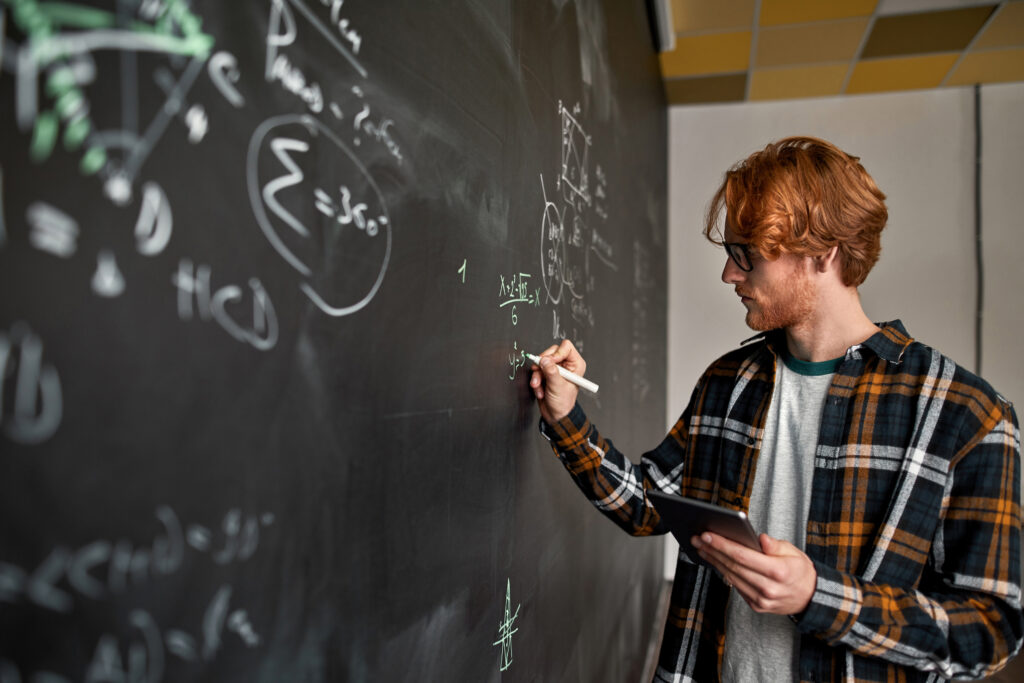
In this episode of School’s In, Candace Thille, faculty director for the Stanford Accelerator for Learning's Adult and Workforce Learning initiative, discusses how to build on prior knowledge and target skills for adult learners, and the intersection of machine learning and human agency.
read →
Link to read
Young caucasian man with digital tablet writing math formula with marker on blackboard in classroom.

AI helps math teachers build better “scaffolds”

Education researchers have evaluated the ability of large language models (LLMs) to help middle school math teachers structure tiered lessons to reach diverse skill levels — a strategy called scaffolding.
read →

A selection of in-progress work by the Stanford Accelerator for Learning, centered around the latest research about AI’s effective and responsible implementation in education.

AI Hub for Education
Making AI research approachable
The AI Hub for Education, part of the Stanford Accelerator for Learning's SCALE Initiative, maintains a comprehensive repository of the research being done on generative AI in K–12 education. This repository includes descriptive research on how AI is being used in classrooms or on how tools are built, impact research testing how well interventions work, and review research studying data to find patterns.
SCALE x OpenAI
Digging into ChatGPT's new "study mode"
A new collaboration between Stanford’s SCALE Initiative and OpenAI, the creator of ChatGPT, strives to better understand how students and teachers use the popular AI platform and how it impacts learning. The research will explore areas such as how specific features like ChatGPT’s new “study mode” affect student learning. In schools specifically, the research will examine how both K-12 teachers and students use ChatGPT.
FIND video coaching
Supporting caregivers of young children
Through video-coaching interventions supported by machine learning, Filming Interactions to Nurture Development (FIND) creates impact by increasing caregiver skills in responsive interactions which support the development of children’s language, self- regulation and social-emotional development. FIND is a program of the Stanford Center on Early Childhood, a program of the Stanford Accelerator for Learning.

The Accelerator engages Stanford students with mentorship, education, immersion, and funding opportunities, activating a new generation of innovators connecting AI and the learning sciences.

Link to read
Two medical students work together on a team assignment.

Stanford education scholar uses AI to help medical students hone diagnostic skills

Doctoral student Marcos Rojas bridges education, medicine, and computer science with a platform that simulates patient-physician interactions.
read →
Link to read
A student presents their project to a group of attendees.

Cultivating a generation of education innovators activating learning science
The new program launched by the Stanford Accelerator for Learning helps Stanford students find their place in the education innovation ecosystem.
read →
Link to read
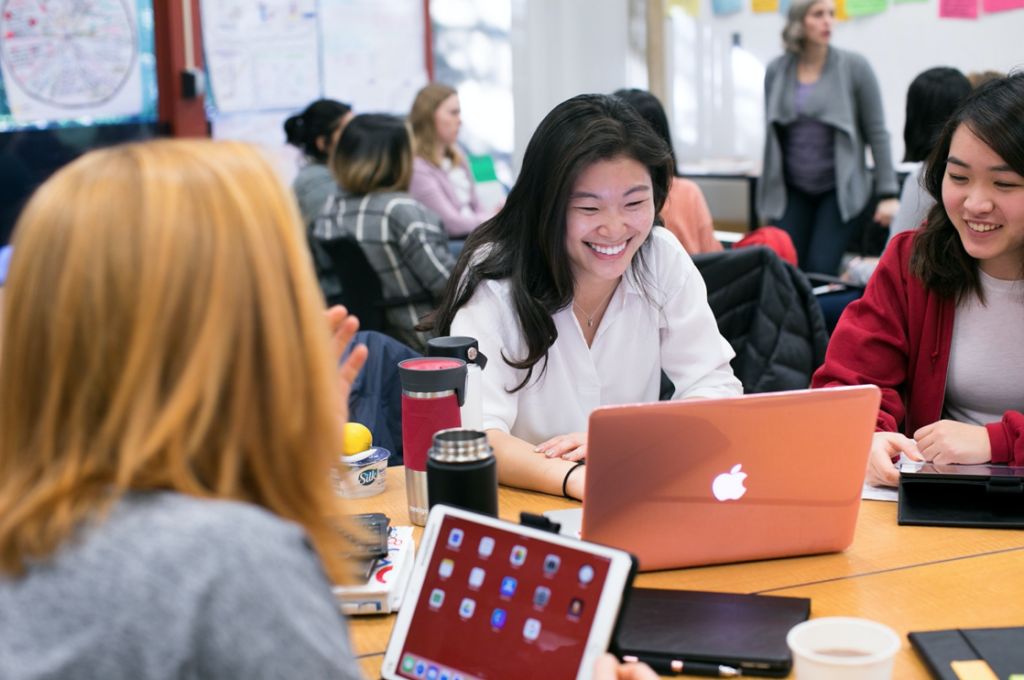
Students on tablets and laptops consult together, laughing.

A Sandbox for change: The Learning Design Challenge and its impact

Now recruiting its fourth cohort, the two-quarter course helps Stanford students from across disciplines come up with new ways for technology to support learning.
read →

Our faculty directors, who head the six initiatives at the Accelerator, all study how AI will impact their research areas and the future of education. The Accelerator also supports Stanford faculty across disciplines working in the intersection of AI and learning through our seed grants and convening opportunities.
Headshot of Dan Schwartz

Dan Schwartz

The Halper Family Faculty Director, Stanford Accelerator for Learning and Faculty Director, Digital Learning Initiative

Headshot of Philip Fisher

Philip Fisher

Faculty Director, Stanford Center on Early Childhood

Headshot of Victor Lee

Victor Lee

Faculty Lead, AI + Education

Headshot of Chris Lemons

Chris Lemons

Faculty Director, Learning Differences Initiative

Headshot of Susanna Loeb

Susanna Loeb

Faculty Director, SCALE Initiative

Headshot of Candace Thille

Candace Thille

Faculty Director, Adult and Workforce Learning Initiative

Headshot of Maisha T. Winn

Maisha T. Winn

Faculty Director, Equity in Learning Initiative

Headshot of Maneesh Agrawala

Maneesh Agrawala

Forest Baskett Professor

Headshot of Adam Banks

Adam Banks

Professor

Headshot of Russell Berman

Russell Berman

Walter A. Haas Professor of the Humanities
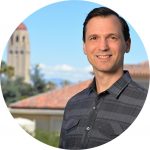
Headshot of Michael Bernstein

Michael Bernstein

Associate Professor

Headshot of Emma Brunskill

Emma Brunskill

Associate Professor

Headshot of Thomas Caruso

Thomas Caruso

Clinical Professor

Headshot of Chris Chafe

Chris Chafe

Duca Family Professor

Headshot of Geoffrey Cohen

Geoffrey Cohen

Professor

Headshot of Todd Coleman

Todd Coleman

Associate Professor

Headshot of Rhiju Das

Rhiju Das

Professor

Headshot of Dora Demszky

Dora Demszky

Assistant Professor

Headshot of Judith Fan

Judith Fan

Assistant Professor

Headshot of Chelsea Finn

Chelsea Finn

Assistant Professor

Headshot of Karin Forssell

Karin Forssell

Senior Lecturer

Headshot of Hyowon Gweon

Hyowon Gweon

Associate Professor

Headshot of Nick Haber

Nick Haber

Assistant Professor

Headshot of Arvind Karunakaran

Arvind Karunakaran

Assistant Professor

Headshot of David Kelley

David Kelley

Professor

Headshot of Christina Krist

Christina Krist

Associate Professor

Headshot of Anshul Kundaje

Anshul Kundaje

Associate Professor

Headshot of James Landay

James Landay

Anand Rajaraman and Venky Harinarayan Professor

Headshot of Jennifer Langer-Osuna

Jennifer Langer-Osuna

Associate Professor

Headshot of Christopher Manning

Christopher Manning

Thomas M. Siebel Professor in Machine Learning

Headshot of Bruce McCandliss

Bruce McCandliss

Professor

Headshot of John Mitchell

John Mitchell

Mary and Gordon Crary Family Professor

Headshot of Roy Pea

Roy Pea

David Jacks Professor of Education & Learning Sciences

Headshot of Christopher Potts

Christopher Potts

Professor

Headshot of Nilam Ram

Nilam Ram

Professor

Headshot of Shima Salehi

Shima Salehi

Assistant Professor (Research)

Headshot of J Kenneth Salisbury, Jr.

J Kenneth Salisbury, Jr.

Professor (Research) Emeritus

Headshot of Elizabeth Schumann

Elizabeth Schumann

Assistant Professor

Headshot of Michael Snyder

Michael Snyder

Stanford W. Ascherman Professor of Genetics
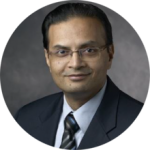
Headshot of Sakti Srivastava

Sakti Srivastava

Professor (Teaching)

Headshot of Randall Stafford

Randall Stafford

Professor

Headshot of Hari Subramonyam

Hari Subramonyam

Assistant Professor (Research)

Headshot of Ge Wang

Ge Wang

Associate Professor

Headshot of Carl Wieman

Carl Wieman

Cheriton Family Professor and Professor of Physics and of Education, Emeritus